

From "Chatting" to "Orchestrating"
If your 2026 AI strategy still relies on employees copy-pasting prompts into a chat box, you aren't using AI—you're just using a faster typewriter.
The most successful organizations have moved into the era of Agentic AI. While a standard AI tool waits for a command, an Agentic System is proactive. It doesn't just "suggest" a reply; it researches the lead, cross-references your Unified AI Platform, updates the CRM, and triggers a personalized video ad from your Media Pipeline autonomously.
This is the shift from "tools" to "teams"—a digital workforce that executes while you sleep.
The Hard Truth: The 95% Failure Rate vs. The 333% ROI
Recent data from the 2025-2026 fiscal cycle reveals a stark divide in AI adoption. While 95% of enterprise AI pilots delivered zero measurable ROI last year, the top 5% of "AI-first" leaders saw an average of 333% ROI and a 10-25% gain in EBITDA.
Why the difference? Most businesses are stuck in "Pilot Purgatory," treating AI as a series of disconnected tools. The leaders have shifted their focus to production-grade agentic architecture. They aren't just testing agents; they are running them as core parts of their P&L.
> "The winners in 2026 won't be those with the smartest models, but those with the most resilient agentic orchestration."
Advanced Agentic Patterns: The "DNA" of Modern Workflows
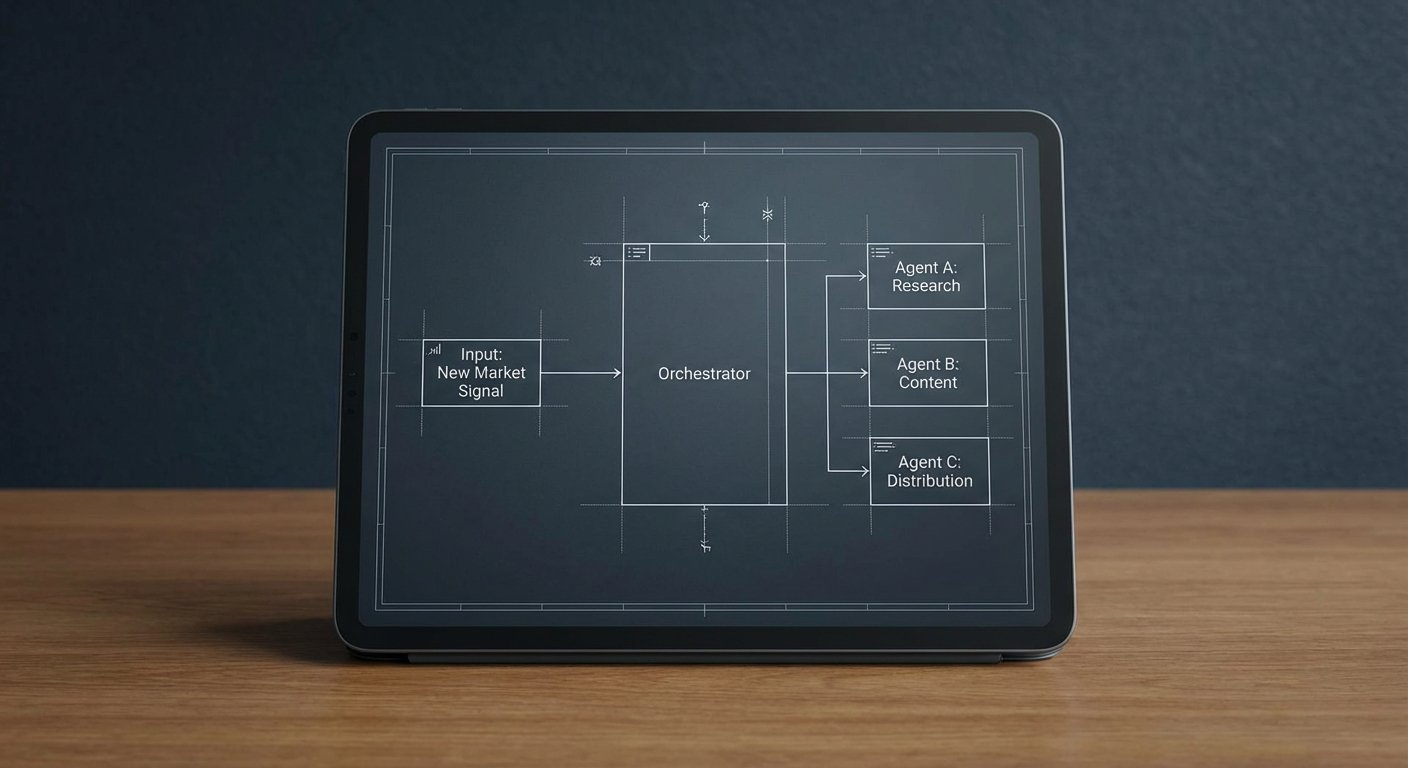
To join that top 5%, you must move beyond simple "GPT-style" interactions. In the DIMA ecosystem, we use three primary architectural patterns to ensure reliability:
1. ReAct (Reasoning + Acting)
This is the "reflex" of your business. The agent observes a signal (like a support ticket), reasons through the policy, and acts immediately. It's best for high-velocity tasks like lead triage or routing.
2. Plan-and-Execute
Used for complex goals like "Generate a 30-page market expansion report." The system first creates a strategic plan, then executes each step (researching, drafting, verifying) sequentially. This prevents the "hallucination loops" common in simpler AI systems.
3. Planner-Critic-Executor
This is the gold standard for high-stakes workflows (e.g., contract drafting or financial reporting). A Planner drafts the work, a Critic reviews it against your company's Compliance & Security Standards, and an Executor only publishes the final result once it's verified.
The Economics of Agents: Managing Token Inflation
A major "hidden cost" in 2026 is token consumption inflation. Multi-agent systems can consume up to 450% more compute than simple chat tools because agents "talk" to each other in the background.
To scale profitably, DIMA has implemented Agentic Cost Gateways. We set per-request caps—for example, a support agent might have a $0.10 budget, while a strategic research agent has a $1.00 budget. This ensures your Business AI System doesn't run away with your bottom line.
Real-World Case Study: Hyper-Automated Revenue Ops
Let's look at how a 200-person SaaS company used the DIMA Multi-Agent System to scale their customer acquisition:
Phase 1: Discovery: A Discovery Agent monitored real-time triggers across LinkedIn and news feeds. It identified 500 leads in 48 hours who were recently promoted to "Head of Ops."
Phase 2: Contextualization: A Knowledge Agent pulled specific data from the company's internal knowledge base to find which case studies matched the industry of each lead.
Phase 3: Execution: A Distribution Agent triggered personalized outreach, including a 15-second video generated by their Autonomous Media Pipeline. The Result: Lead-to-response time dropped from 4 hours to 4 seconds, and conversion rates increased by 42% without hiring a single additional sales rep.

AI Search Ready (AEO): Why This Matters for Your Visibility
In 2026, the search landscape has shifted toward Answer Engine Optimization (AEO). People don't just "Google" for tools; they ask their AI: "Which multi-agent system provides the best ROI for a B2B sales team?"
To ensure your business is the answer, your content must be structured as grounded truth. DIMA agents are built on a "Fact-First" architecture, ensuring that every claim they make is cited from your company data. This isn't just good for accuracy; it's how AI search engines like ChatGPT and Perplexity decide which brands to recommend.
Building Your Agentic Workforce with DIMA
You don't need a PhD in AI to build these systems. At DIMA, we’ve pioneered the Visual Agent Builder.
- Select Your Agents: Choose from specialized digital workers in Sales, Finance, or Ops.
- Define the Hand-off: Use plain language to describe how the Researcher Agent should pass data to the Sales Agent.
- Monitor with Audit Trails: Every action, decision, and token spent is logged for SOC 2 and GDPR compliance.
Conclusion: The New Barrier to Entry
In the old world, the barrier to entry was capital. In 2026, it is Systemic Intelligence. The gap between businesses that use tools and those that build agentic systems is widening. One is fighting for crumbs; the other is scaling infinitely.
Are you ready to lead your digital workforce? Explore how DIMA's Multi-Agent Orchestration can transform your growth engine today.
FAQ: Common Questions on Agentic AI
Q: Does Agentic AI require a massive budget?
A: No. While enterprise setups can be significant, the DIMA platform allows you to start with a single agentic workflow for a department and scale as you see measurable ROI.
Q: How do I handle the "Black Box" problem?
A: DIMA provides full transparency. Every "Agent Card" on your kanban board allows you to click and see the Chain-of-Thought reasoning, showing exactly why the AI made a specific decision.
Q: Is it safe?
A: All DIMA agents operate within your Encrypted Data Perimeter, meaning your company secrets never train external models.


